
Podium or Mobile Access Tower: Which Should You Use?
A podium is generally suited to low-level, one-person tasks where a compact guarded platform is required. A mobile access tower is more appropriate when the task requires a larger platform, greater platform height or a configuration designed for a particular environment.
Height alone should not determine the decision. The correct choice depends on the task, risk assessment, working area, platform space, ground conditions, access requirements and the manufacturer’s instructions.
What is the difference between a podium and a mobile access tower?
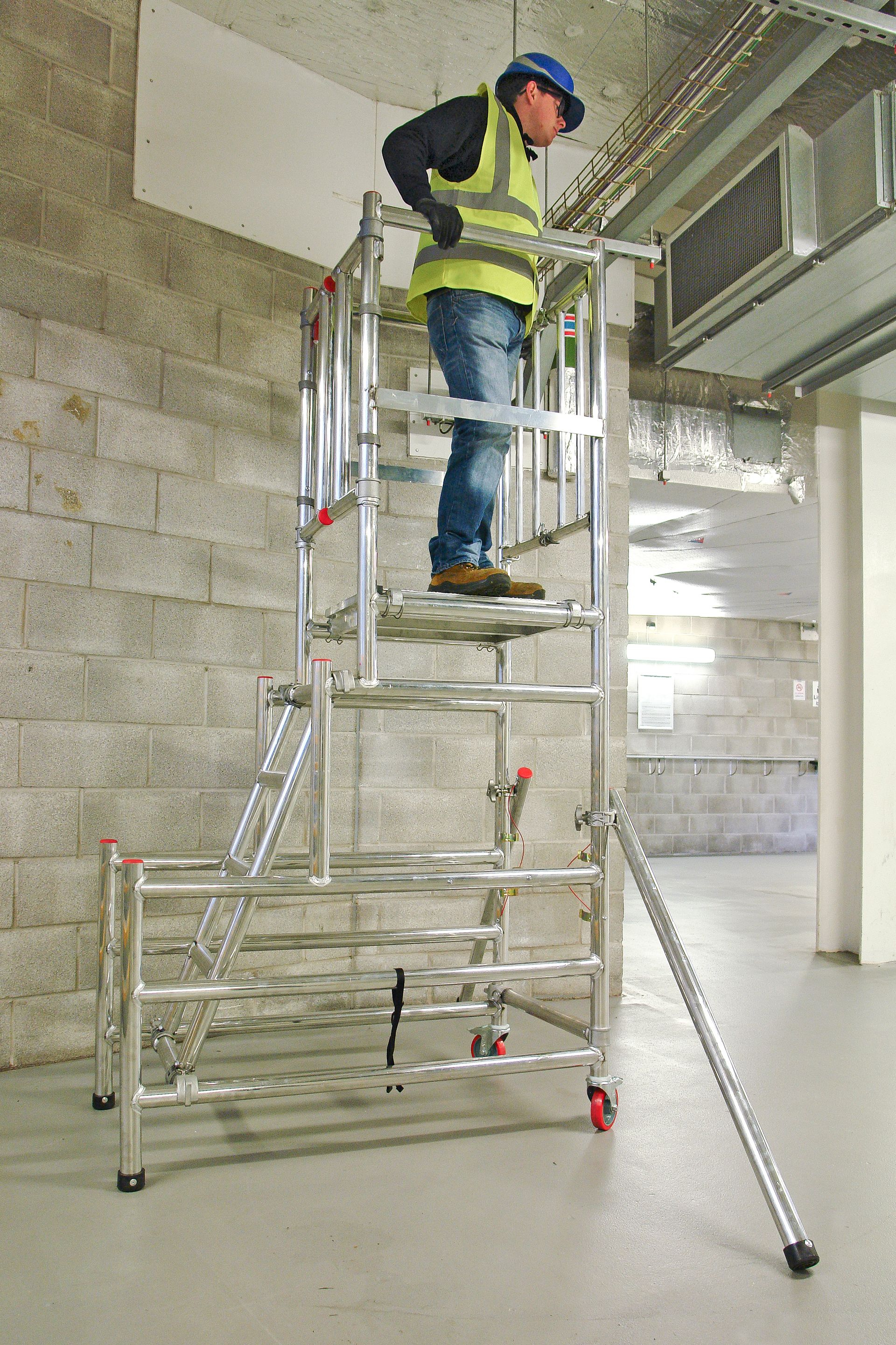
A podium, also known as a low-level work platform or podium step, provides a guarded platform for one person carrying out low-level work. Podiums are often compact, easy to reposition when unoccupied and suitable for work in rooms, corridors and other restricted areas.
A mobile access tower is a prefabricated structure with a working platform, guardrails, internal access and castors. It provides collective fall protection and is available in a wider range of platform heights, lengths and widths.
Both are forms of work-at-height equipment. Neither is automatically the correct choice for every task.
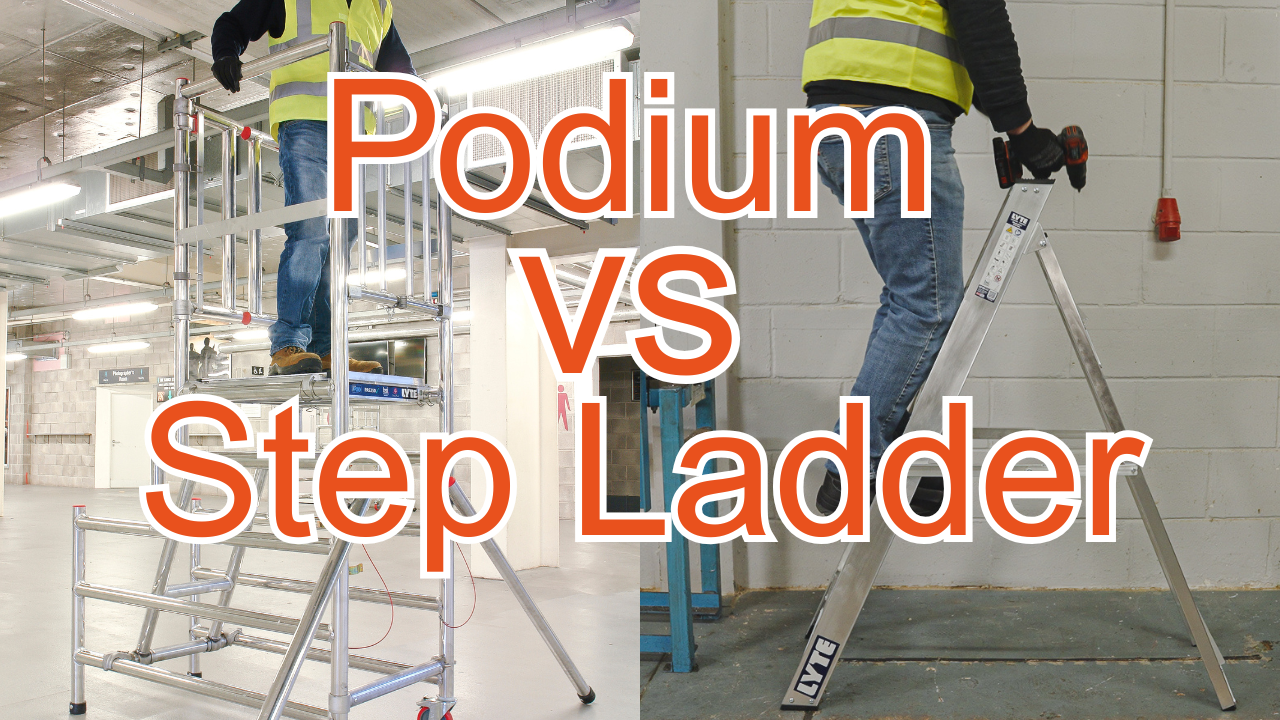
Podium versus mobile access tower: quick comparison
| Consideration | Podium or low-level platform | Mobile access tower |
|---|---|---|
| Typical application | Low-level, one-person work | Work requiring more platform height, space or a specialist configuration |
| Platform height | Up to 1.5m, depending on the product | Standard BS EN 1004-1 towers can cover platform heights up to 8m outdoors and 12m indoors, subject to the manufacturer’s design |
| Working area | Compact platform | Larger platform, with single and double-width options available |
| Users | Normally designed for one person | Determined by the tower configuration and permitted platform and structural loads |
| Fall protection | Guardrails, gates or other protection specified by the manufacturer | Guardrails, toeboards, bracing and safe internal access |
| Product standard | BS 8620 for low-level work platforms | BS EN 1004-1:2020 for standard mobile access towers |
| Assembly | Product-dependent | Must follow the manufacturer’s approved assembly method |
| Best suited to | Low-level maintenance, fitting, inspection and finishing work | Installation, maintenance and other tasks requiring a larger or higher working platform |
Always check the individual product’s certification, permitted platform height, load information and instruction manual.
When should you use a podium?
A podium may be appropriate when:
- the work is at a relatively low level;
- one person needs a guarded working platform;
- the user needs both hands available for the task;
- the equipment must fit through doorways or operate in a restricted area;
- the task involves repeated low-level work from a stable platform; and
- the platform height and dimensions are suitable for the required reach.
Typical applications include electrical and mechanical fitting, ceiling work, inspection, decorating and facilities maintenance.
A podium should not be selected simply because it is quick to move. It must provide the correct platform height without encouraging the user to stretch, lean outside the guardrails or stand on the guardrails or any other part not intended as a working surface.
Low-level work platforms should be certified to BS 8620 and used in accordance with their instruction manual.
When should you use a mobile access tower?
A mobile access tower may be more suitable when:
- the required platform height is outside the range of the available podium;
- the task requires a larger working platform;
- the work involves tools or materials that can be safely accommodated within the permitted load;
- the task will be undertaken over a wider area at the same level;
- collective fall protection is required around the working platform; or
- a specialist tower configuration is needed, such as work on a stairway.
Mobile towers are commonly used for installation, inspection, painting, plastering, facilities maintenance and mechanical or electrical work.
The tower must be suitable for the intended configuration and environment. Do not improvise by leaving out components, combining incompatible parts or altering the structure.
What standards apply to podiums and mobile access towers?
- BS 8620 - This is the British standard for low-level work platforms with one working platform and a maximum platform height no greater than 2.5m.
- BS EN 1004-1:2020 - This standard covers mobile access and working towers manufactured from prefabricated components. It includes requirements relating to materials, dimensions, design loads, safety and performance. The associated standard BS EN 1004-2:2021 covers the content of instruction manuals for these towers.
Some configurations sit outside BS EN 1004-1. These include stepped towers, linked towers, cantilever towers, large-deck towers and towers used to access another place. Relevant configurations may instead be covered by BS 1139-6:2021 and may require specialist training, design information and additional documentation.
Product certification does not remove the need for a risk assessment, competent users, correct assembly or inspection.
Do you legally need PASMA training to use a tower?
The Work at Height Regulations do not state that every tower user must hold a PASMA card.
They require employers and those controlling work at height to ensure that the work is properly planned, appropriately supervised and carried out by competent people. HSE guidance states that towers should be erected and dismantled by people who are trained and competent, and that users should understand the hazards and precautions involved.
PASMA training is a recognised way of developing and demonstrating this competence. The appropriate course should match the equipment and configuration being used. Standard mobile towers, low-level platforms and specialist tower configurations require different knowledge and skills.
An employer should not assume that general site experience, or experience with ladders, makes someone competent to assemble or use a mobile tower.
How should a mobile tower be assembled?
Always follow the current instruction manual supplied by the manufacturer, hirer or supplier.
For a standard mobile access tower, the assembly system will normally use either:
- Advance Guardrail, where guardrails are installed from the level below before the user accesses the next platform; or
- Through the Trapdoor, or 3T, where the user works through the platform trapdoor to install or remove guardrails without standing on an unguarded platform.
Never stand on an unprotected platform during assembly or dismantling.
PASMA’s principle is straightforward: no instruction manual should mean no tower.
What should you check before using a tower or podium?
Before use, confirm that:
- the equipment is the correct type and height for the task;
- the risk assessment covers the location, users, work and environment;
- the ground or supporting surface is firm, level and capable of supporting the equipment;
- every required component is present and undamaged;
- frames, braces, platforms, guardrails, gates and toeboards are correctly fitted;
- castor brakes are applied;
- stabilisers or outriggers are fitted as specified in the manual;
- safe internal access is available;
- the platform is free from unnecessary materials and trip hazards;
- the total load will remain within the manufacturer’s limits;
- there are no overhead power lines or other obstructions;
- weather and wind conditions are suitable; and
- the required inspection has been completed.
Do not use equipment with missing, damaged or incompatible components.
How often must a mobile access tower be inspected?
All towers must be inspected after assembly and then at suitable intervals by a competent person.
If a tower is used for construction work and a person could fall 2m or more from the working platform, it must be inspected:
- after assembly;
- before being used;
- at intervals not exceeding seven days;
- after substantial alteration; and
- after an event that may have affected its stability or structural integrity.
The inspection result must be recorded and retained until the next inspection is recorded.
A pre-use check should also be carried out before each working session. If the equipment appears damaged, incomplete or unsafe, stop work and prevent its use until the problem has been resolved.
Can you move a mobile access tower while someone is on it?
No. HSE states that a tower must never be moved while people or materials remain on it.
Before moving a tower:
- Remove people, tools and materials.
- Reduce its height to no more than 4m.
- Check for overhead cables, door frames, pipework and other obstructions.
- Check that the route is firm, level and free from potholes.
- Follow the manufacturer’s instructions regarding stabilisers.
- Push or pull the tower manually from the base only.
- Reapply the castor brakes and complete the necessary checks before reuse.
- Never move a tower in windy conditions.
Can you put a ladder on top of a podium or tower?
No. Do not use a ladder, stepladder, trestle, box or other object on the working platform to gain additional height. Doing so raises the user above the protection provided by the guardrails and may destabilise the structure. If the platform is too low, select equipment designed to provide the required platform height.
Never lean a ladder against a tower or climb the outside of the structure. Use only the tower’s designated internal access.
Can a mobile access tower be used outdoors?
A tower can be used outdoors if its design, configuration and instruction manual permit it and the risk assessment confirms that conditions are suitable.
BS EN 1004-1 standard tower configurations can extend to a maximum platform height of 8m outdoors, but this does not mean every tower can be used at that height. The permitted height depends on the product, configuration and manufacturer’s instructions.
Wind conditions must be monitored. Stop work and dismantle or secure the tower in accordance with the manufacturer’s instructions when conditions become unsafe.
Do not attach sheeting, netting, advertising boards or similar materials to a standard mobile tower unless the structure has been specifically designed for the additional wind loading. These materials can act like sails and cause the tower to overturn.
Can tools and materials be used on the platform?
Yes, provided that:
- the combined load remains within all specified platform, deck and structural limits;
- the materials can be handled safely;
- the working platform and access route remain clear;
- nothing creates a trip hazard;
- objects cannot fall from the platform; and
- the work does not create excessive horizontal or wind loading.
The stated load may include the user, other permitted occupants, tools and materials. Check the instruction manual rather than relying on a general load figure.
Large sheets, signs, cladding or similar materials require particular care because wind pressure and manual handling forces can destabilise a tower. Always follow the manufacturer's guidance on this.
How do you choose the correct equipment?
Ask these questions before selecting a podium or tower:
- Can the task be completed from ground level?
- What platform height is required, rather than simply the overall working height?
- How much platform space does the task require?
- How many people, tools and materials will be on the platform?
- Is the equipment intended for indoor or outdoor use?
- Is the ground firm, level and unobstructed?
- Are there overhead services, doorways or other restrictions?
- Will a standard configuration work, or is a specialist design required?
- Can competent people assemble, inspect and use it?
- Is the current instruction manual available?
The Work at Height Regulations require work at height to be avoided where reasonably practicable. Where it cannot be avoided, suitable equipment should be used to prevent falls. Towers and guarded podiums provide collective protection, but only when selected, assembled and used correctly.
Summary
Choose a podium when the task is low-level, requires one person and can be completed safely from a compact guarded platform.
Choose a mobile access tower when the task requires a larger platform, greater platform height or a tower configuration designed for the working environment.
In every case:
- complete a risk assessment;
- use properly certified equipment;
- follow the manufacturer’s instructions;
- ensure assemblers, inspectors and users are competent;
- fit every required component;
- stay within the permitted load and height;
- inspect the equipment at the required intervals; and
- stop work if anything is missing, damaged or unsafe.
If a standard podium or tower does not safely meet the task requirements, do not improvise. Seek advice on a suitable standard or specifically designed access solution.
Sources and further guidance
HSE: The Work at Height Regulations
HSE: Introduction to working at height safely
PASMA: Towers and low-level access equipment guide
PASMA: Current tower product standards
PASMA: Safe use of a scaffold tower
Selecting from the Lyte range
The equipment should follow the risk assessment, not the other way around. Within the Lyte range:
- LytePod provides a compact, adjustable low-level platform tested to BS 8620.
- Lorry LytePod is an adapted LytePod which is ideal for accessing the rear of lorries and trucks.
- OneLyte provides a compact industrial tower designed for assembly by one competent person.
- HiLyte500 is available in single and double-width configurations up to 12m for large-scale industrial tasks.
- StairLyte is a specialist tower designed for stairway work and certified to BS 1139-6.
- LIFT is a narrow folding tower designed for compact transport and restricted working areas.
- LyteMate is a mobile, lightweight platform for interior trades.
- Lyte Boxing Ring Tower is designed for elevated workspaces over flat roofs, buses, trains, containers and welfare units.
Always check the individual specification, permitted configuration and instruction manual before choosing a product.